
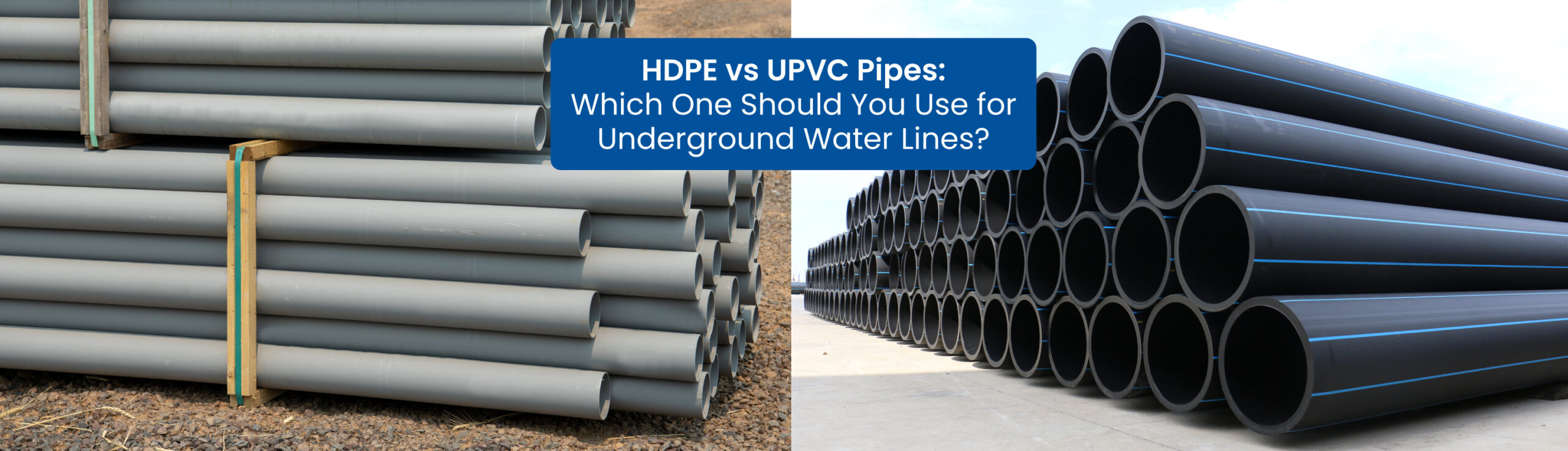
You’re standing at the hardware shop — or maybe on a construction site — and someone asks: HDPE or UPVC? And suddenly a simple plumbing decision feels like a university exam question. Both are popular. Both are plastic. Both work underground. So what’s actually the difference, and more importantly, which one should you choose?
Let’s cut through the technical jargon and talk about this like a real conversation — because the right answer depends on your specific situation, and getting it wrong means digging everything back up. As a trusted pvc pipe company, Savera Pipes has been helping customers make this choice for decades.
What Exactly Are These Two Pipes?
HDPE stands for High-Density Polyethylene. It’s a flexible, tough plastic pipe that bends without breaking and handles impact well. It comes in long coils and is joined using heat fusion — a process where pipe ends are melted and fused together permanently.
UPVC stands for Unplasticised Polyvinyl Chloride. It’s a rigid, hard pipe that doesn’t bend — which is actually a strength in the right application. UPVC pipes are joined using solvent cement, making installation straightforward without any special equipment.
Where HDPE Genuinely Wins
If your underground water line needs to travel across uneven terrain, around trees, or through areas with shifting soil — HDPE is your friend. Its flexibility means it absorbs ground movement without cracking. In earthquake-prone zones or areas with heavy vehicle traffic above, this flexibility acts as a natural shock absorber for the pipeline.
HDPE also handles slightly higher pressures and is ideal for long-distance water supply lines — the kind used in municipal water projects and agricultural main lines. Savera Pipes, recognized among leading hdpe pipe manufacturers in hyderabad, manufactures HDPE pipes to IS 4984 standards, ensuring consistent wall thickness and pressure ratings that hold up across years of continuous service underground.
Where UPVC Is the Smarter Choice
For most household and building underground water lines — think the pipe running from your overhead tank to the kitchen, or the main supply line entering a residential plot — UPVC is honestly the better option. It’s easier to cut, easier to join, and significantly easier to repair if something goes wrong.
UPVC also has excellent chemical resistance, which matters more than people realise. Underground soil in many parts of South India is mildly acidic or carries trace minerals that slowly degrade weaker materials. Savera Pipes UPVC Pressure Pipes are built with this in mind — offering long-term resistance to soil chemicals and maintaining water quality inside the pipe for decades. For exposed sections, proper outdoor pvc pipe insulation further enhances longevity.
The Cost Conversation
Generally, HDPE pipes cost slightly more than UPVC for the same diameter and length. For a small household underground line, that difference adds up. But for a large agricultural or infrastructure project where flexibility and long runs matter, HDPE’s higher upfront cost is justified by lower installation complexity and fewer joints — which means fewer potential leak points.
With Savera Pipes, both options are priced competitively and backed by the same quality assurance — ISI certification, consistent wall thickness, and over three decades of manufacturing experience from their Siddipet plant in Telangana. As a reliable pvc pipe company, they ensure that whether you choose HDPE or UPVC, you’re getting a product designed for real-world conditions.
So, Which One Should You Actually Use?
Here’s a simple way to decide: if the line is long, crosses uneven ground, or runs through a large agricultural or municipal project — go HDPE. If it’s a residential plot, building compound, or short underground run with standard soil — UPVC is your most practical and cost-effective choice.
What matters most is not picking the “better” pipe in theory — it’s picking the right pipe for your ground, your pressure needs, and your budget. Both HDPE and UPVC from Savera Pipes are built to last underground, tested to Indian standards, and backed by a team that understands South Indian soil conditions better than most.
